














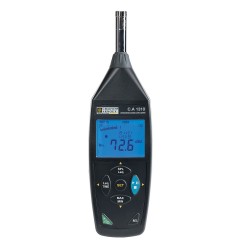

After-Sales and Services
MANUMESURE is the Chauvin Arnoux Group company which provides services in France. Via its 17 Technical Centres and metrology laboratories spread across the whole of France, with 120 engineers and qualified technicians, MANUMESURE offers industrial companies and institutions a comprehensive range of services
- calibration for all brands, in the laboratory or on site
- management of measuring instrument fleets
- maintenance and repairs
- regulatory testing and verifications: nuclear, medical, atmospheric waste emissions, EMC, etc.
Jobs proposed:
- Maintenance technicians, experienced or beginners
- Metrological technicians
- Pollution test technicians
- Agency managers
Profiles sought:
- BTS/DUT/ higher technical diploma in Electronics, Electrotechnics, Electrical Engineering, Physical Measurements
- Experienced or beginners
- Good relational skills, sense of service
Support Functions
To keep a international industrial group like Chauvin Arnoux running, a large number of other resources are required, in addition to design, manufacturing, product commercialization and provision of services.
Some of these resources are outsourced, but others are provided in-house.
Departments with occasional job openings:
- Human Resources
- Accounting
- Purchasing and Procurement
- Communication
- IT
- General Services
Mapping
Temperature mapping of climatic chambers, furnaces, ovens, etc.
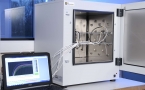

MANUMESURE has COFRAC “Tests” accreditation for temperature mapping
from - 80 °C to + 400 °C
Accreditation no. 1.1623
Scope available at www.cofrac.fr
Six Manumesure technical centres (*) are available to perform these characterizations on site for industrial companies, laboratories, hospitals and manufacturers of furnaces, ovens, freezers, etc.
(*) Technical centres in Lille, Lyon, Marseille, Paris, Pont-L'Evêque & Strasbourg (France)
Characterizations can be performed according to the French NF X 15-140 reference document or the European NF EN 600068 reference document, as required.
Methodology
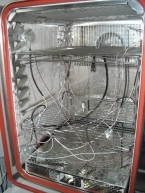
Measurements by comparison with standard probes:
- at 9 points for chambers smaller than 2 m3
- at 15 points for volumes larger than 2 m3
Simulation of door opening-closing shows the reaction time of the chamber.
A “verification report” groups the measurement results, the calculation of the uncertainties, the setpoint deviation and the homogeneity and stability of the chamber.
Maintenance & Repairs
Manumesure carries out repairs and maintenance of all brands of instruments

Ever since it was first set up, Manumesure has provided after-sales service for instruments from the Chauvin Arnoux Group's brands.
Drawing on this experience, Manumesure has also specialized in repairing instruments from any manufacturer and proposes industrial maintenance of measuring systems.
Our engineers and technicians are specially trained and can work on customers' sites for industrial maintenance, or repair electrical and electronic instruments in our 12 technical centres spread across France.
Our expertise
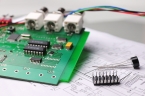
Manumesure's expertise is guaranteed by dedicated human and technical resources, computerization and traceability of the diagrams, centralized management of replacement parts and metrological traceability to the national standards.
Low-Voltage Directive
If the safety test report and EMC test report are satisfactory, they enable approval of the CE label on the device
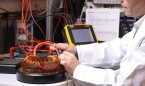
There are 2 parts to the LVD: EMC and electrical safety
Electrical safety is covered by directive 2006/95/CE issued by the European Parliament and the Council on 12th December 2006. It concerns electrical devices intended for use in the following voltage conditions:
-
-
- between 50 V and 1,000 V for alternating current
- between 75 V and 1,500 V for direct current
-
Applicable standards:
- NF EN 61010-1. Concerns electrical measuring, control and laboratory devices. General requirements.
- NF EN 61010-2-030. Specific requirements for test and measurement circuits.
- IEC 61010-031. Safety instructions for equipped handheld probes for electrical measurements and tests.
- IEC 61010-2-032. Specific requirements for portable and handheld current sensors for electrical tests and measurements.
- IEC 61010-2-033. Specific requirements for portable multimeters and other measuring devices for domestic and professional use which are capable of measuring the network voltage.
The safety assessment of a device is performed jointly by several people (engineering teams) while taking into account the data concerning the design of the device. In short, the safety test report is a summary of a device's design.
EMC
Qualify the Electromagnetic Compatibility of your equipment
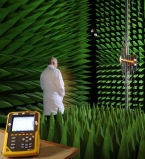
Manumesure has an Electromagnetic Compatibility (EMC) test laboratory at its technical centre in Pont-L’Evêque (France).
The Chauvin Arnoux Group's measuring instruments and equipment are all qualified in this laboratory.
This laboratory is also available for industrial companies seeking to qualify the electromagnetic compatilibility of their equipment with regard to the EMC regulations.
Please do not hesitate to contact us.
EMC, CE marking and the European Directive
Electromagnetic compatibility (abbreviation: EMC) is the capability of a device or system to operate satisfactorily in an electromagnetic environment, without causing intolerable electromagnetic disturbances for everything else in the environment.
European Directive 2004/108/CE replacing Directive 89/336/CE makes EMC tests mandatory for all electrical and electronic devices. It obliges industrial companies to place CE marking on all such products, thus proving that they comply with the EMC standards applicable to them (among other aspects).
Immunity tests
According to the NF EN 61000-4-2 ... 4-11 standards
61000-4-2: Electrostatic discharges: contact discharge 8 kV - air discharge 15 kV
61000-4-3: Radiated immunity:
-
-
-
-
- 3 V/m at 3 metres between 80 MHz and 2.7 GHz
- 10 V/m at 3 metres between 80 MHz et 2.5 GHz
-
-
-
61000-4-4: Fast transients and bursts:
-
-
-
-
- 4 kV with direct injection on single-phase and three-phase coupler
- 4 kV by coupling clamp
-
-
-
61000-4-5: 1.2/50 µs shock waves: 4 kV by single-phase coupler
61000-4-6: Conducted radio-frequencies: 3 V and 10 V between 150 kHz and 80 MHz with CDNs (coupling-decoupling networks) and injection clamp
61000-4-8: Magnetic field: 100 A/m in Helmholtz coils
61000-4-11: Short interruptions and voltage dips: single-phase test
Susceptibility tests
According to the NF EN 55011 standard
Radiated emissions: from 30 MHz to 1 GHz at 3 metres. Automated turntable and antenna for in-depth determination of the maximum values
Conducted emissions: measurement with single-phase LISN from 150 kHz to 30 MHz
Water quality
Water quality sampling and analysis
Analyses according to specifications

MANUMESURE can test the quality of waste water, rain water and underground water on any site.
Various parameters can be measured according to the customer's specifications: pH, temperature, chemical oxygen demand, pesticides, BOD5, suspended solids, PCBs, total hydrocarbons, heavy metals, nitrates, etc.
Waste water and rain water quality tests
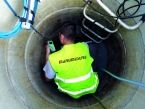
Sampling and methodology
Sampling is performed in compliance with the ISO 5667 standards on water sampling and the FD T 90-523-2 document: "Water Quality - Sampling guide for monitoring water quality in the environment - Waste water sampling".
Two types of sampling are possible: 24-hour survey or point sampling.
24-hour survey
Sampling using a flow-controlled or time-controlled sampling system with continuous measurement of pH and temperature. When sampling has finished, an average sample representative of the day when measurement took place is established and analysed.
This sampling method allows assessment of the average daily values for waste water.
Point sampling
This method, used to assess the instantaneous value for an effluent, is used for effluent which remains homogeneous over time or for effluent linked o a specific event: rain, accidental pollution, etc.
Types of analyses
Various parameters can be measured according to the customer's specifications: pH, temperature, chemical oxygen demand, pesticides, BOD5, suspended solids, PCBs, total hydrocarbons, heavy metals, nitrates, etc.
Monitoring of underground water quality
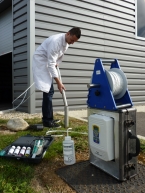
This sampling and analysis has two main aims:
- Checking that water quality has not been altered by agricultural, industrial or other activities.
- Detecting any pollution or monitoring the evolution of a pollution event already detected.
Methodology
These measurements are performed in compliance with AFNOR technical document FD X31-615 "Soil quality - Methods for detecting and characterizing pollution - Sampling of underground water in a bore-hole".
Our technical resources enable us to take samples at depths of up to 70 metres.
Types of analyses
Various parameters can be measured according to the customer's specifications: pH, temperature, chemical oxygen demand, pesticides, BOD5, suspended solids, PCBs, total hydrocarbons, heavy metals, nitrates, etc.
Measurement report
At the end of the measurement campaign, a report is drawn up presenting the methodology, a site description, the analysis results and a comparison with the regulated values.
Noise measurement
Noise-level measurements on the property lines of industrial sites
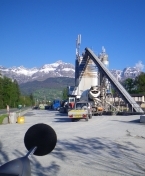
Manumesure performs regulatory noise-level tests on installations classified as environmentally sensitive.
These measurements are intended to check the noise levels on the property lines of industrial sites (excluding buildings) and in regulated noise emergence areas.
Two French decrees (dated 20/08/85 and 23/01/97) provide the reference in terms of regulations.
Methodology
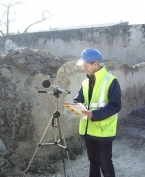
The measurements are performed with Class-1 sound-level meters, in compliance with the NF S 31-010 standard concerning “Characterization and measurement of environmental noise”.
- Acquisition of the noise levels is performed during a period representative of the company's normal operations (minimum 30 minutes) and requires suitable climatic conditions (no heavy rain or high winds).
- The admissible noise levels on the site's property lines are tested at the locations specified by the regulations. If this is not possible, the measurement locations are determined according to the respective positions of the installation and the regulated noise emergence areas, so that the potential effect of the installation's noise emissions on inhabited areas can be assessed representatively.
Report
At the end of the measurement campaign, a report will be drawn up presenting the methodology, the measurement results (admissible levels on property lines, noise emergence, noticeable tones) and compliance with the regulations.
Quick response all over France
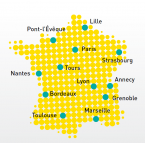
With its network of technical centres covering the whole of France, Manumesure is capable of responding quickly to any requests.
Each centre includes technicians qualified for noise measurements and high-performance equipment.
Air quality measurement
25 years of expertise in air quality analysis
Watch the video (in French)
Accreditations & approval
Manumesure est accréditée COFRAC Tests ,
conformément au
document de référence « Qualité de l’air, NF X 43-551Emissions de sources fixes:
• Reux / Lyon / Nantes / Grenoble (France) – Accréditation COFRAC Tests
n° 1-7496
Manumesure a reçu l’agrément du ministère français de la Transition écologique et solidaire.
Our services
Testing of atmospheric waste emissions

Manumesure travaille sur place pour effectuer des tests réglementaires sur les émissions de déchets atmosphériques, avec l'accréditation COFRAC Tests.
- Mesure de la vitesse et de la température (ISO 10 780)
- Mesure de l'humidité (NF EN 14 790)
- Mesure en continu des gaz : O₂ , CO₂ , CO, NOx, COV, CH₄
- Mesure des poussières (NF 44 052/EN 13-284) , PM10 et PM2,5 (ISO 23 210) , analyse granulométrique
- Mesure des métaux, HF, HCl, SO2 , NH3 , N2O , acidité et alcalinité
- Mesure des dioxines et des furanes (PCDD/PCDF) (EN 1948-1)
- Mesure des hydrocarbures aromatiques polycycliques (HAP) (NF 43-329)
- Molécules spécifiques sur demande (benzène, goudron, COV spécifiques, etc.)
Verification of automatic measurement systems
La réglementation relative à l'incinération des déchets et aux installations de combustion importantes impose aux exploitants de contrôler leurs équipements de mesure en continu, utilisés pour la surveillance automatique des émissions atmosphériques.
MANUMESURE vérifie les systèmes de mesure automatique (SMA) installés sur les cheminées industrielles conformément aux procédures QAL 2 et AST, avec l'accréditation COFRAC Tests.
QAL 2 :
Vérification de l'assurance qualité de l'installation des systèmes de mesure automatique par des mesures effectuées en parallèle avec des méthodes de référence normalisées. La procédure QAL 2 doit être réalisée tous les 3 ans. MANUMESURE intervient sur site pendant 4 jours. La première journée est consacrée aux essais opérationnels. Durant les 3 jours suivants, plusieurs séries de mesures sont réalisées en parallèle sur l'analyseur. Au moins 15 mesures doivent être effectuées. À la fin de l'opération, une série d'analyses statistiques est utilisée pour établir la fonction d'étalonnage du SMA et déterminer si l'analyseur est capable de satisfaire aux exigences en termes de mesures et d'incertitudes.
AST : Test de surveillance annuel.
La procédure AST est réalisée une fois par an (en l'absence de QAL 2). Son objectif est de vérifier la validité des fonctions d'étalonnage définies lors de la validation QAL 2 pour le système de mesure automatique (AMS). Les travaux se déroulent sur deux jours consécutifs. Le premier jour, des tests opérationnels sont effectués, suivis d'au moins cinq mesures simultanées sur l'analyseur.
Measurement of diffuse emissions
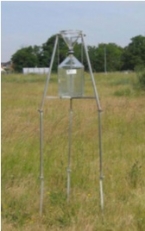 MANUMESURE mesure les émissions diffuses en mettant en œuvre diverses techniques d'échantillonnage.
- mesure des concentrations de poussière et de métaux
- mesure des concentrations de dioxine/furane
- dosage du benzène, du formaldéhyde, etc.
- Mesures spécifiques sur demande
Measurement of ambient air quality in public buildings
Le décret français 2011-1728 du 2 décembre 2011 relatif au contrôle de la qualité de l'air intérieur dans certains bâtiments publics stipule que ce contrôle sera mis en œuvre par étapes, avec quatre échéances.
- Avant le 1er janvier 2015 pour les bâtiments assurant la garde collective d'enfants (environ 9 000) et les écoles maternelles (environ 17 000)
- Avant le 1er janvier 2018 pour les écoles primaires (environ 38 000)
- Avant le 1er janvier 2020 pour les centres de loisirs extrascolaires (33 000) et les établissements d'enseignement secondaire et de formation professionnelle (environ 17 000)
- Avant le 1er janvier 2023 pour les autres bâtiments publics
MANUMESURE a développé une expertise en matière de mesure de la qualité de l'air ambiant afin de répondre aux exigences de ces nouvelles réglementations et de vous accompagner dans :
- évaluation des systèmes de ventilation
- définition des stratégies d'échantillonnage
- Deux campagnes de mesure annuelles : une campagne lorsque les systèmes de chauffage sont en fonctionnement, avec mesure du CO₂ , du benzène et du formaldéhyde ; et une campagne lorsque les systèmes de chauffage sont à l’arrêt, avec mesure du benzène et du formaldéhyde.
Fleet of mobile laboratories
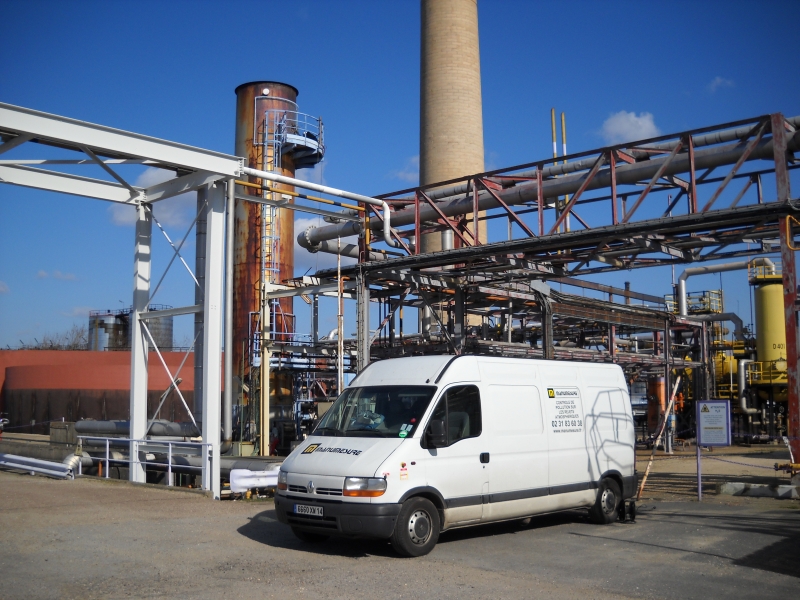 MANUMESURE dispose d'une flotte de laboratoires mobiles lui permettant d'intervenir sur les sites de ses clients en France et dans les pays voisins.
Infrared thermography
Manumesure performs safety inspections using infrared thermography.
Our expertise
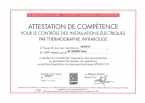
MANUMESURE's operators are certified by the CNPP (French national centre for prevention and protection), as per APSAD* reference document D19, for the inspection of electrical installations by infrared thermography.
(*) French plenary assembly of damage insurance companies
Purpose of inspections using infrared thermography
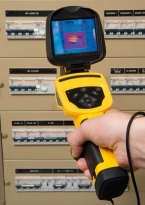
Infrared thermography is a no-contact inspection technique used in a wide variety of sectors: electricity, mechanics, metallurgy, construction, etc.
This technique is used for preventive maintenance, as well as in production and R&D.
Applications in the electrical sector: viewing load unbalances, searching for abnormal hot spots, detecting bad connections in electrical cabinets which may cause a fire or service interruption, etc.
Methodology
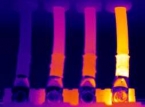
The electrical installation inspections performed by MANUMESURE operators comply with technical document D19 published by the CNPP ( French national centre for prevention and protection)
This service is finalized by a Q19 report and a document detailing corrective recommendations for the anomalies detected.
